Fifteen to twenty grains, every single gallon.
Water hardness is measured in grains per gallon. Above 7 grains counts as hard. Municipal supply across Cave Creek, Carefree and north Scottsdale typically tests 15 to 20+ grains — more than double the threshold, and among the hardest water in the country. Private wells north of Carefree Highway frequently test higher.
That mineral load does not stay in the water. It comes out of solution wherever water sits, heats or evaporates, and it starts building the day the house is connected. Most homeowners here have made peace with the white crust on the showerhead. The crust is the visible tenth of the problem.
Where the money actually goes
Hard water rarely breaks anything outright. It shortens lifespans, quietly, across every piece of equipment that touches water. In rough order of what it costs you:
- Your water heater. Minerals settle to the tank bottom and bake into a crust that insulates the burner from the water it is meant to heat. The unit runs longer for the same hot water, costs more to run, and dies years early. This is the single largest line item hard water writes.
- Dishwasher and washing machine. Scale forms on internal heating elements and narrows valves and lines. These are appliances you replace, not repair.
- Fixtures and cartridges. Scale seizes the moving parts inside faucet cartridges and mixing valves. A cartridge that should last a decade starts dripping in three years.
- Glass, stone and tile. Mineral deposits etch shower glass permanently. Past a certain point it cannot be cleaned off — only replaced.
- Soap and detergent. Hardness minerals bind with surfactants before they can do their job, which is why the soap never quite lathers and the laundry comes out stiff. You are buying detergent the minerals cancel.
The tell most people miss
If your water heater rumbles or pops when it fires, that is not the burner. It is water flashing to steam underneath a layer of sediment. The sound means the crust is already thick enough to hold heat against the tank bottom — the exact mechanism that ends a tank early. More on that in our guide to how long a water heater really lasts here.
Softener, conditioner or filter — the honest taxonomy
Water treatment is full of overlapping labels, and the marketing does not help. Three genuinely different things get sold under similar names.
True softeners: salt-based ion exchange
Water passes through a resin bed that swaps calcium and magnesium ions for sodium, then periodically rinses itself clean in a regeneration cycle. This is the only technology that actually removes hardness, which is why it is the only one that ends scale on fixtures, protects a water heater and changes how a shower feels. Sized correctly, a quality unit runs 10–15 years on nothing but salt refills.
Conditioners and “salt-free softeners”
These do not remove hardness. They alter how the minerals crystallise so less scale adheres to surfaces. In mild water that is worth something. In 15–20 grain water, the honest description is scale reduction, not softening — your soap still will not lather and your tank still collects sediment. The Encore systems we install belong in this category, and we say so plainly rather than letting the “salt-free softener” label do the talking. Sometimes a conditioner genuinely is the right answer, usually where an HOA or septic setup rules out a discharge line.
Whole-house filtration and RO
Carbon filtration handles the other common complaint about Valley water — chlorine taste and smell. It does nothing for hardness. Combo systems pair a softener with carbon media so you address both in one footprint. If drinking water is the priority, a reverse-osmosis tap at the kitchen sink finishes the job for pennies a gallon, and the softener upstream protects the RO membrane.
Sizing is arithmetic, not a guess
Softener capacity is rated in grains — how much hardness it captures before it has to regenerate. Sizing one correctly is multiplication: your measured hardness times the gallons your household actually uses per day gives the daily load, and the right unit handles roughly a week of that between cycles.
Get it wrong in either direction and you pay. An undersized softener regenerates constantly, burning salt and water and wearing its resin out early — one of the reasons for a sudden high water bill. An oversized one sits idle long enough for the resin bed to channel. This is why we ask how many people live in the house before we talk about models, and why one-size-fits-all quotes so often disappoint in water this hard.
On a well or hauled water? Test first, quote second.
North of Carefree Highway — New River, Desert Hills, parts of Rio Verde — plenty of homes run on private wells or hauled storage. Well water can carry iron, sulfur or sediment that a standard softener is not built to handle alone, and treating it right sometimes means pre-filtration ahead of the softener. A softener fighting iron it was never designed for is a warranty claim on a schedule. We test what is actually in your water first.
The cheapest day to install one
The day a new water heater or tankless unit goes in is the best day to add softening. The new equipment starts life protected instead of accumulating scale from day one, and doing both in a single visit saves on labour. If you are already facing a heater replacement, ask for the combined number — it is almost always less than the two jobs quoted separately.
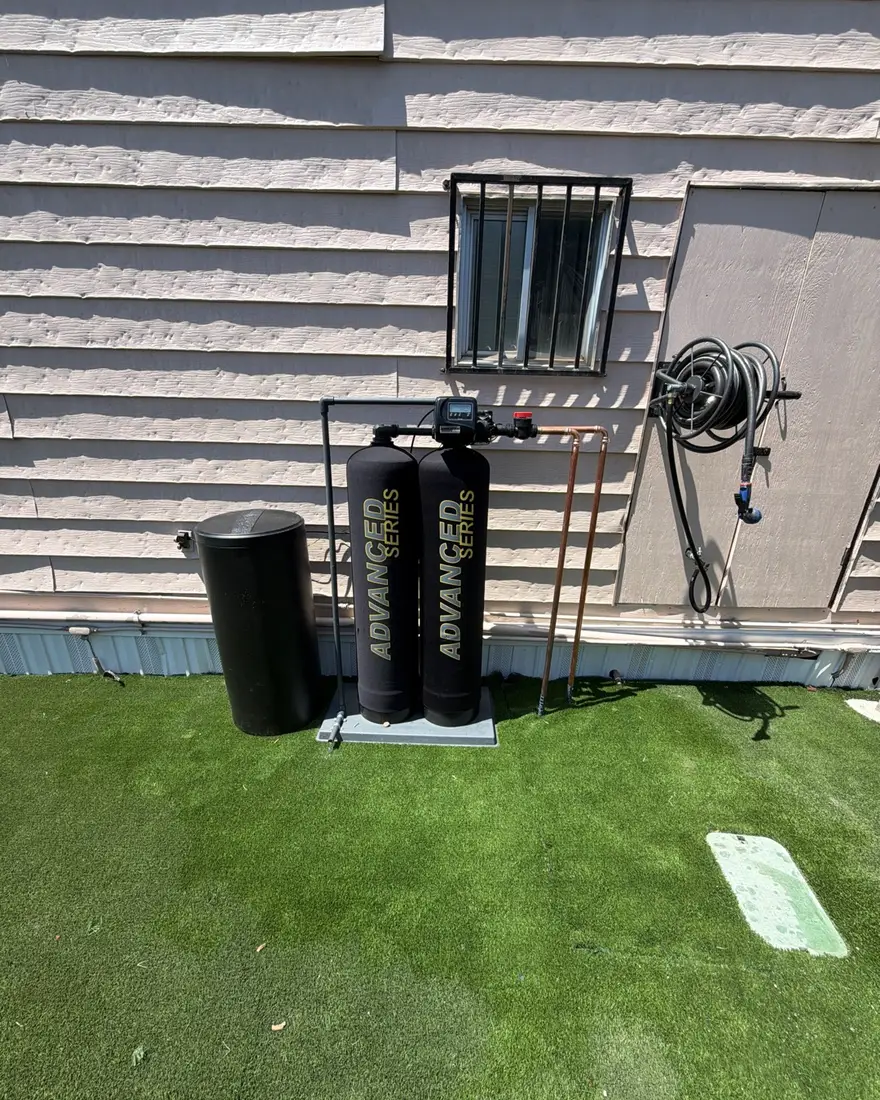
Estimates on softener installation are free. We test your actual grains per gallon, size to your real usage, and plumb it with a bypass valve so the unit can be taken offline for service without touching the rest of the house. Outdoor installs get UV-resistant jacketing, because the desert sun is hard on everything.