
The design life and the desert reality
A standard tank water heater is engineered for roughly 12 to 15 years. Across Cave Creek, Carefree, north Scottsdale and Desert Ridge, an unflushed tank usually delivers 8 to 12. That gap is not bad luck and it is not a manufacturing defect. It is two local conditions working on the same appliance.
The first is our water. At 15–20+ grains per gallon, dissolved minerals drop out of solution as the water heats and settle on the tank floor, where they bake into an insulating crust. The burner then has to drive heat through that crust to reach the water. The unit runs longer for the same result, the steel at the bottom runs hotter than it was designed to, and the tank fails from the inside out.
The second is where these units live. A garage in Cave Creek spends months above 100°F ambient, and many summer afternoons well past 110°F. That is not the environment the design assumed. It accelerates everything.
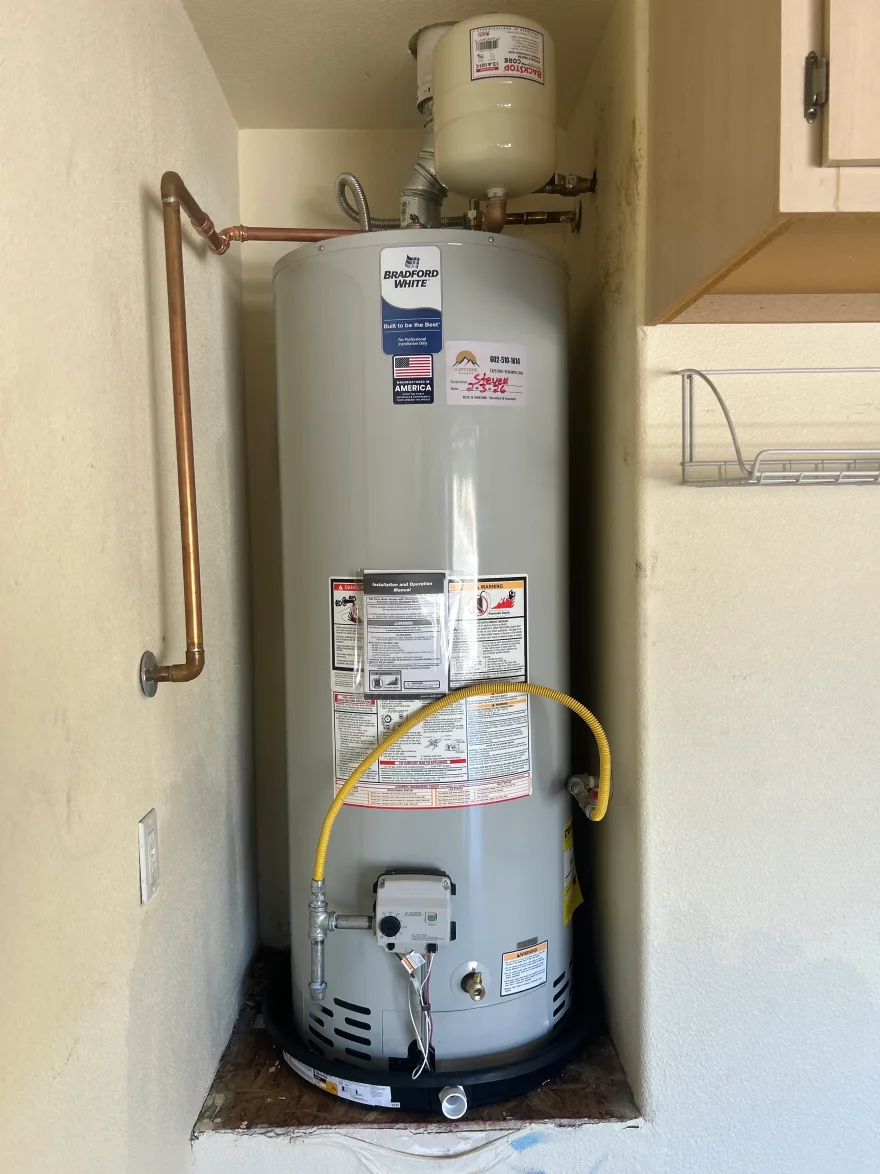
Reading the warning signs
Tanks rarely fail without notice. They give you months of signals first, and most homeowners read them as quirks rather than a countdown.
- Rumbling or popping when it fires. The classic hard-water symptom. That is water flashing to steam underneath the sediment layer. It means the crust is already established.
- Hot water runs out faster than it used to. Sediment occupies volume. A 50-gallon tank with three inches of scale on the floor is not a 50-gallon tank any more.
- Rusty or metallic-tasting hot water. Often the anode rod is spent and the tank itself has started to corrode. This one is closer to the end than the others.
- Longer recovery time. The burner is fighting the insulating layer. You will see it on the gas bill before you see it at the tap.
- Water pooling at the base. If the tank body is weeping, that is replacement, not repair. Corrosion has broken through and no fix reverses it.
- A pilot that will not stay lit. Usually a thermocouple — genuinely repairable, often same-visit, and not a sign the tank is finished.
Water pooling at the base? Do this first.
Close the cold-water shutoff valve on top of the heater, or the home’s main. Turn the gas control to “off”, or flip the breaker for an electric unit. Then call (602) 510-1614. Stopping the water first is the difference between a plumbing bill and a drywall-and-flooring bill.
Repair or replace: the framework we actually use
Every company says it is honest about this call. Here is the reasoning our plumbers apply, so you can check ours against it — or anyone else’s.
- Under 8 years old with a fixable part → repair. Elements, thermostats, thermocouples, gas valves and T&P valves are all serviceable. A young tank with one bad part has plenty of life left.
- The tank itself is leaking → replace. Water weeping from the tank body means internal corrosion has broken through. Nothing reverses that, and a failing tank can let go all at once.
- 15+ years old facing a major repair → replace. Spending serious money on a unit at the end of its design life is bad math. We will still show you the repair number, and tell you which one we would pick for our own garage.
- Third repair on the same unit → replace. Repeat failures are the tank telling you something. At that point repair money is rent, not investment.
Buying the missing years back
The gap between design life and desert reality is not fixed. Three things close most of it, and none of them are expensive.
An annual flush
Draining the sediment before it hardens is the single highest-return maintenance on the unit. Done yearly, the crust never establishes. Skipped for five years, the flush becomes a gamble — sediment can jam an old drain valve open, which is its own emergency. Our home plumbing maintenance checklist puts the flush on the calendar alongside the rest of the house.
Checking the anode rod
The anode is a sacrificial metal rod that corrodes so the tank does not. It is the least understood part of a water heater and one of the most important. In water this aggressive it burns through faster than almost anywhere in the country. Replacing a spent anode costs a fraction of a tank and can add years.
Softening the water upstream
Everything above treats the symptom. A water softener addresses the cause by removing the minerals before they ever reach the tank. If you are keeping the house, this is the upgrade that protects the most other equipment at once — the full picture is in our guide to what hard water costs you here.
Two heaters? Stagger them.
Larger North Valley homes often run two or three tanks, and they almost always went in the same week. That means they age out the same season. When the first one goes, replacing it resets that clock — and it is the natural moment to plan the second on your schedule instead of its own.
What moves the price
We diagnose first, then quote in writing before any work starts. These are the levers, so any quote you receive — from us or anyone — makes sense to you:
- Size and fuel type. 40 versus 50 gallon, gas versus electric.
- Code items. Expansion tank, drain pan, seismic strapping and venting brought to current code. These belong on an honest quote, not as a surprise afterwards.
- Access. A garage-floor swap is straightforward. An attic or interior-closet install is not.
- Condition of the existing valves and supply lines. Corroded connections get replaced, not reused.
- Warranty length on the unit you choose. Longer-warranty tanks cost more today and less over a decade.
Estimates on replacement are free, haul-away of the old unit is included, and most swaps finish the same day you call.