
Tankless water heater installation & service.
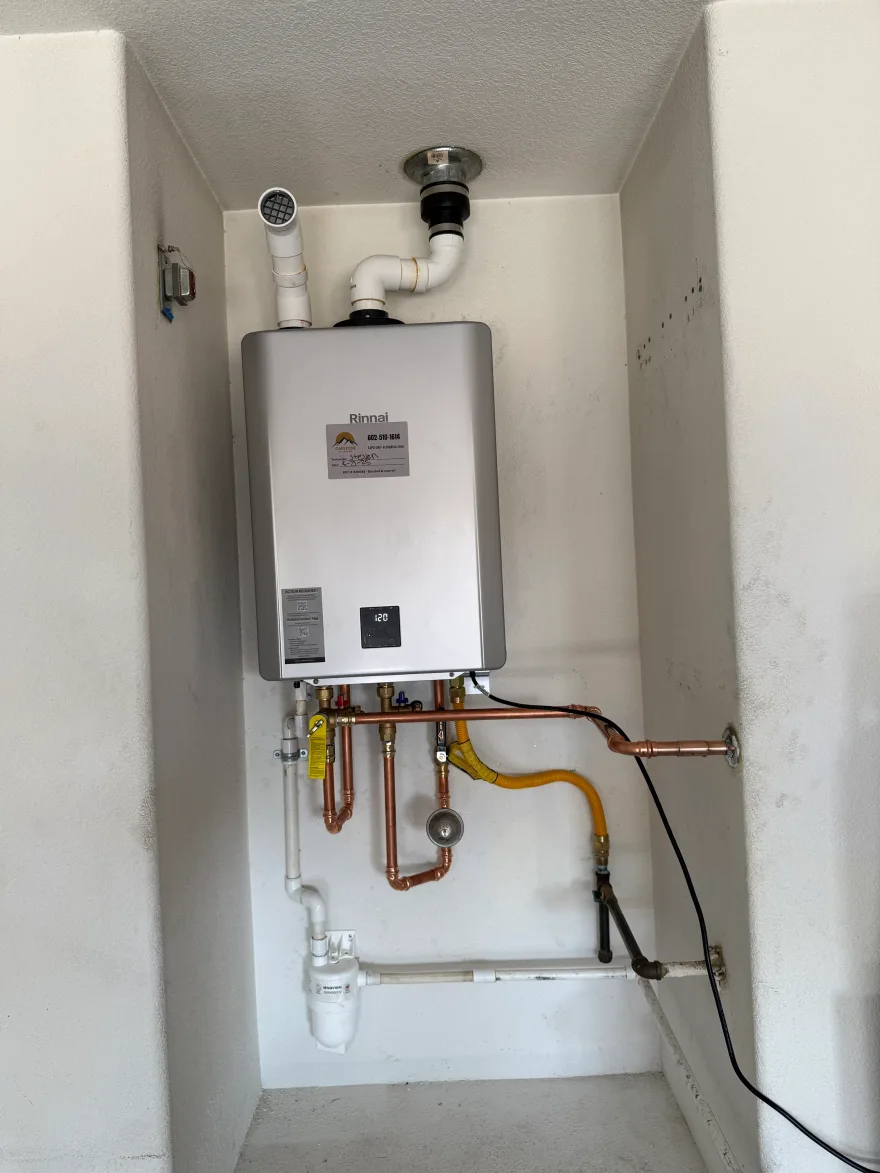
A tankless water heater only heats water when you open the tap — no 50-gallon tank running all day in a 115° garage. Done right, that means lower operating costs, hot water that never runs out, a unit the size of a carry-on bag, and a service life of around 20 years. We install and service the major brands, including the Rinnai units you'll see in our recent work.
"Done right" is the key phrase. Tankless sizing has to match your home's simultaneous demand — showers, dishwasher and laundry running at once — and in North Valley hard water, the heat exchanger needs annual descaling to protect that 20-year lifespan. We handle the full cycle: honest sizing, clean installation, yearly maintenance, and repairs when an error code won't clear.
Tankless services we offer
- New installation and tank-to-tankless conversion. Gas, venting and condensate handled to code.
- Repair and error-code diagnostics. Most codes map to a known cause — bring us the number.
- Annual inspection and descaling. The service that protects the 20-year lifespan in our water.
- End-of-life replacement. When a unit has given its twenty years, we swap it clean.
Is tankless right for your house?
- Choose tankless if… your tank is due for replacement anyway, you keep running out of hot water, or garage space matters.
- Stick with a tank if… your current unit is young and healthy, or upfront budget is the deciding factor. We'll say so.
- Operating cost: tankless heats only on demand — no standby losses — so it's cheaper to run month to month.
- Lifespan: ~20 years for tankless vs. 8–12 for tanks in our hard water — if it's descaled annually.
- Space: wall-mounted, roughly the size of a suitcase. Your garage gets its corner back.
- Hot water supply: continuous. Back-to-back showers, laundry and dishes without the cold surprise.
Endless, not instant: what tankless actually changes
The most common misconception we correct on tankless quotes: tankless means the hot water never runs out — it doesn't mean hot water arrives at your tap faster. The wait you feel at the far bathroom is the cold water sitting in the pipes between the unit and the fixture, and that run is the same length no matter what heats it.
If instant is what you're after, the fix is recirculation. Several tankless models ship with a built-in recirculation pump, and homes without a dedicated return line can use a crossover valve at the far fixture to loop water back through the cold line. We set recirculation on a schedule or a push-button trigger rather than running it around the clock — a loop that circulates all day quietly spends the efficiency you bought the tankless for. Sized and scheduled right, you get both halves: hot water that arrives in seconds and never quits.
What a correct tankless install includes
Sizing by flow, not by brochure
Tankless capacity is measured in gallons per minute at a given temperature rise. A shower draws roughly two gallons a minute; run two showers and a dishwasher and you need a unit that can deliver six-plus while lifting incoming water to 120°F. The desert works in your favor here — our groundwater arrives warm most of the year, so the same unit produces more flow in Cave Creek than it would in Denver. We size against your real simultaneous demand, then sanity-check it against winter inlet temperatures so December showers don't surprise you.
Gas, venting and the details behind the wall
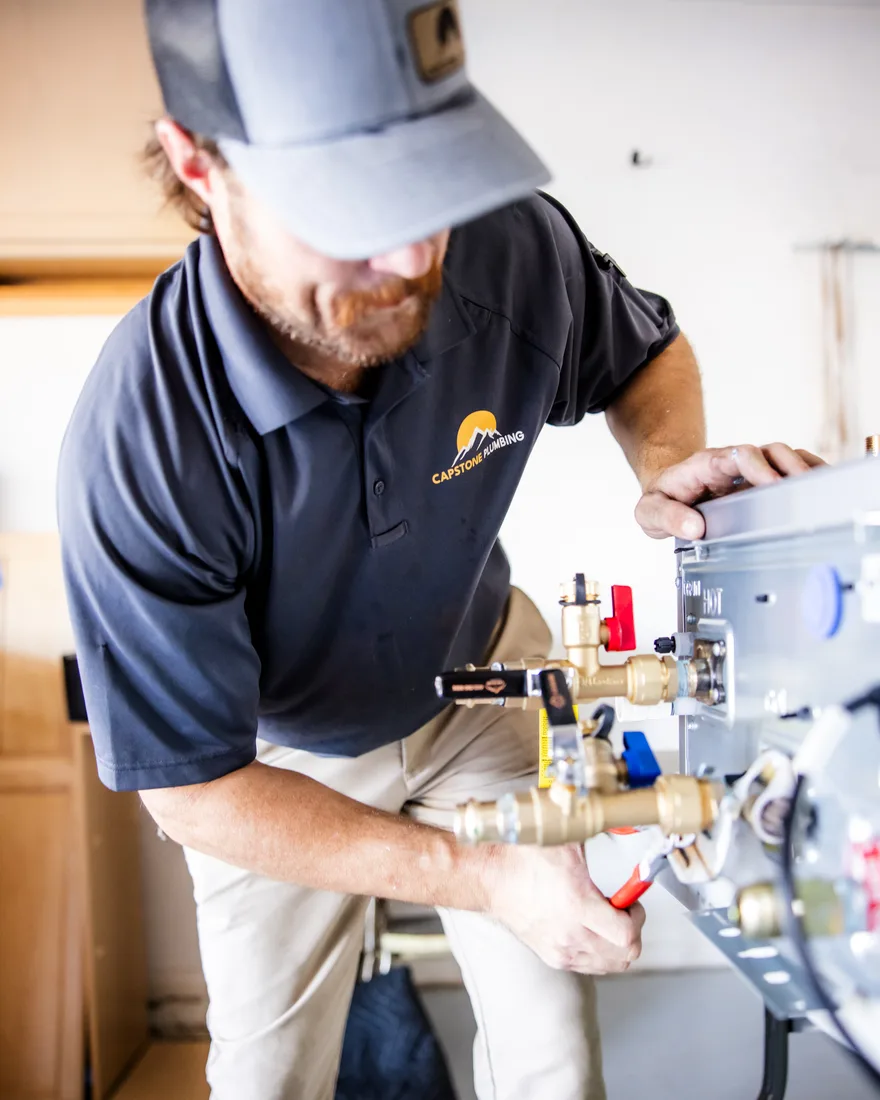
Most tankless units fire a much larger burner than the tank they replace, and the half-inch gas line that fed your old 40-gallon heater often can't feed a tankless at full output. Upsizing that run — plus routing the right venting and a condensate drain on condensing models — is the invisible half of a conversion quote. We also plumb every install with isolation service valves, the fittings that make future descaling a 45-minute service instead of a disassembly project. Skipping them is how cut-rate installs stay cheap; you pay it back at every maintenance visit.
Condensing or non-condensing
Condensing units capture a second round of heat from their own exhaust, which makes them the efficiency pick and lets them vent in PVC instead of stainless steel — but they produce acidic condensate that needs a drain, and sometimes a neutralizer, handled at install. Non-condensing units cost less upfront and suit shorter, simpler vent runs. Which one wins depends on where the unit lives and where the vent can go; we quote the model that fits the house, not the one on promotion.
The annual descale, demystified
Once a year, we circulate a descaling solution through the heat exchanger via those service valves, flushing out the mineral film our 15–20 grain water leaves behind. It takes under an hour, keeps efficiency at spec, prevents the error codes scale causes, and protects both the 20-year lifespan and — with many manufacturers — the warranty itself. Pair the unit with a water softener and the exchanger stays cleaner between services.
Tankless error codes, decoded
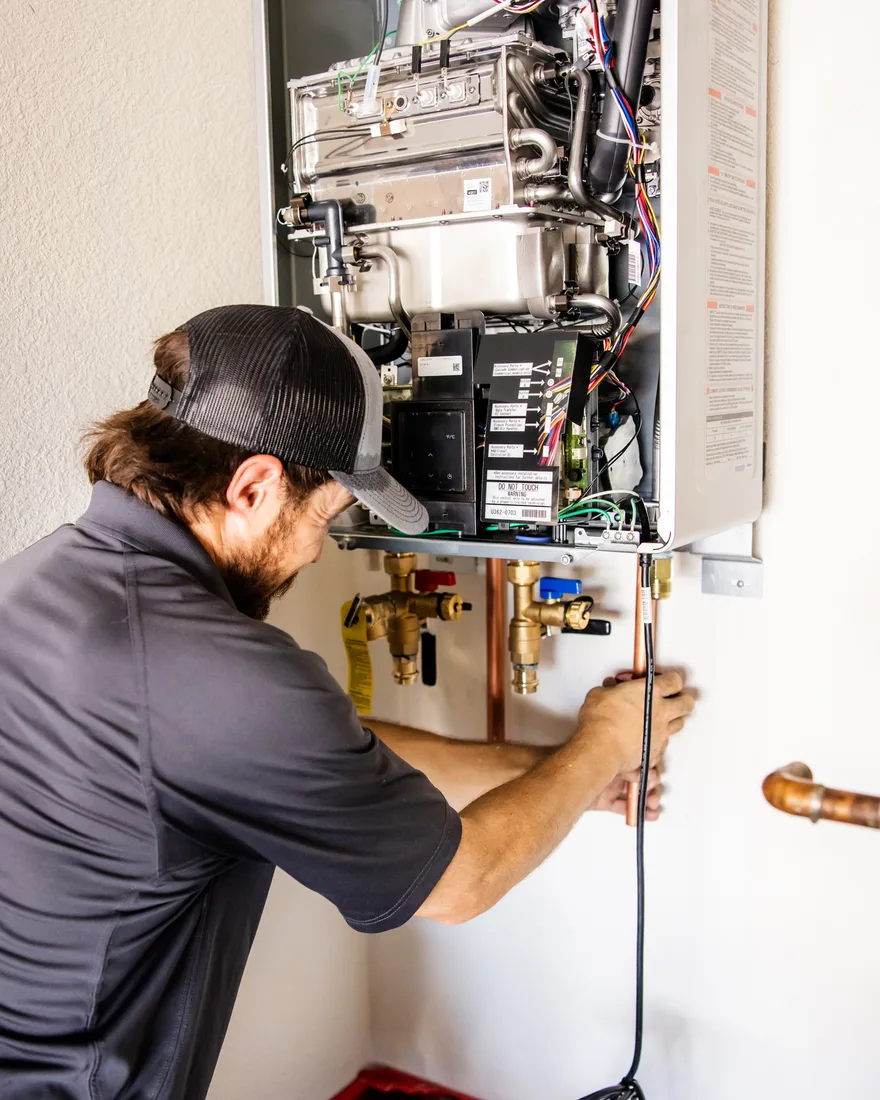
A tankless unit that stops making hot water usually tells you why — a two-digit code on the display. Bring us the number when you call; most map to a known cause. On the Rinnai units common in our recent work, for example: code 11 is an ignition failure, which often traces to gas supply rather than the unit itself; code 12 is a flame lost mid-fire; code 10 points at blocked intake or exhaust venting; and the LC / 00 scale codes are the unit warning that mineral buildup is choking the heat exchanger — the one that shows up early in water this hard when descaling gets skipped. Some of these clear with a genuine fix in under an hour; some are the opening chapter of a warranty claim we can handle with the manufacturer. Either way, the code turns guessing into diagnosis.
A straight word on electric tankless
Whole-home electric tankless rarely pencils out here: heating water on demand with electricity draws enormous amperage, and most panels need expensive upgrades to feed it. Where electric shines is point-of-use — a small unit under the far bathroom or casita sink that kills a long wait without touching the rest of the system. If your situation is electric-only, we'll tell you honestly whether the answer is a point-of-use unit, a heat-pump tank, or keeping what you have.
Our tankless install process
- Size the demand. Fixtures, appliances, simultaneous use, fuel type — we size to your real peak, not a chart.
- Upfront price, both options. Tankless and tank replacement priced side by side, so the decision is yours with real numbers.
- Clean install. Mounted, plumbed with service valves for future descaling, gas and venting done to code.
- Annual descale. A yearly flush keeps the heat exchanger clean and the 20-year lifespan on track.
Hard water warning — this matters more here than almost anywhere.
Scale is the #1 killer of tankless units in the Valley. If you're investing in tankless, pairing it with a water softener protects the heat exchanger, keeps efficiency up, and is often required to maintain manufacturer warranty coverage in water this hard.
What determines tankless installation cost
Tankless quotes vary more than tank quotes because the installation varies more. These are the levers — your price in writing before any work, always:
- Unit capacity. The GPM rating your peak demand requires.
- Gas line upsizing from the old tank's half-inch supply, if needed.
- Venting route. Condensing vs non-condensing models vent differently.
- Old tank removal and haul-away. Included.
- Isolation service valves. Always included — they're what make maintenance affordable.
- Electric models: panel capacity and circuit work where applicable.
Where we install tankless systems
We install and service tankless systems — including the Rinnai units in our recent work — across the North Valley from Cave Creek: Carefree, Scottsdale, Desert Mountain, DC Ranch, Terravita and Desert Ridge. Annual descaling appointments are quick, scheduled visits; most customers pair them with a whole-home checkup.