
We’re not here to sell you the most expensive option.
Tankless is the right call for some North Valley homes and the wrong call for others, and the difference usually has nothing to do with the unit itself. It comes down to how your household uses hot water, what your house can actually support, and what you’re expecting afterwards. If your current tank is doing its job and has years left in it, replacing a working heater with a more expensive one isn’t an upgrade — it’s just a bigger invoice. We’d rather tell you that up front than sell you something you didn’t need.
What follows is the same thinking we apply before quoting a conversion in Cave Creek, Carefree or North Scottsdale, including Desert Mountain, Troon North, DC Ranch, Terravita and Desert Ridge. Three questions, in the order they matter.
There is a $300 manufacturer rebate running right now
Navien is offering a $300 homeowner rebate on qualifying NPE-2 condensing tankless units. Installations must be purchased between August 17 and November 30, 2026, and the claim submitted by December 31, 2026. Residential installations only — new construction and commercial don’t qualify.
The homeowner submits the claim, not us. We can’t file it on your behalf. You’ll need your Capstone invoice showing the model, serial number, install date and address, then submit through Navien with your serial number. Approved rebates arrive as a prepaid Mastercard mailed by Navien. The rebate is subject to Navien’s terms, verification and available funding, so it can end before the posted date.
It’s a genuine saving on the right job. It is not a reason to put the wrong heater in your house — see question one.
1. Does your household actually need tankless?
This is the question that saves people the most money, and it’s the one that gets skipped. Tankless earns its cost in specific situations:
- You run out of hot water. Back-to-back showers, a big soaking tub, laundry and a shower at the same time. A tank has a finite reserve; once it’s gone you wait for recovery. A correctly sized tankless doesn’t have that ceiling.
- You want the floor space back. A tankless unit hangs on a wall. In a garage or a tight utility alcove, that footprint matters.
- Your tank is near the end anyway. If you’re replacing a heater regardless, the gap between a tank and a tankless is a smaller decision than it looks. Our guide to how long a water heater lasts in Arizona covers when that point arrives.
- You plan to stay. Tankless units generally outlast tanks when they’re maintained, so the longer your horizon, the better the arithmetic looks.
And the other side of it: if nobody in the house has ever run out of hot water, your tank is a few years old and it’s working fine, this is a want rather than a need. There’s nothing wrong with wanting it. Just go in knowing that’s what it is.
What we look at: household size, how your hot water actually gets used through the day, the age and condition of the current heater, the space you’d gain, and what you’re working with on budget.
2. Is your home equipped for the switch?
You cannot assume a tankless unit drops into the space a tank came out of. This is where conversion quotes diverge enormously between houses on the same street, and it’s why a price given over the phone without seeing the house is a guess.
Gas supply is usually the deciding factor
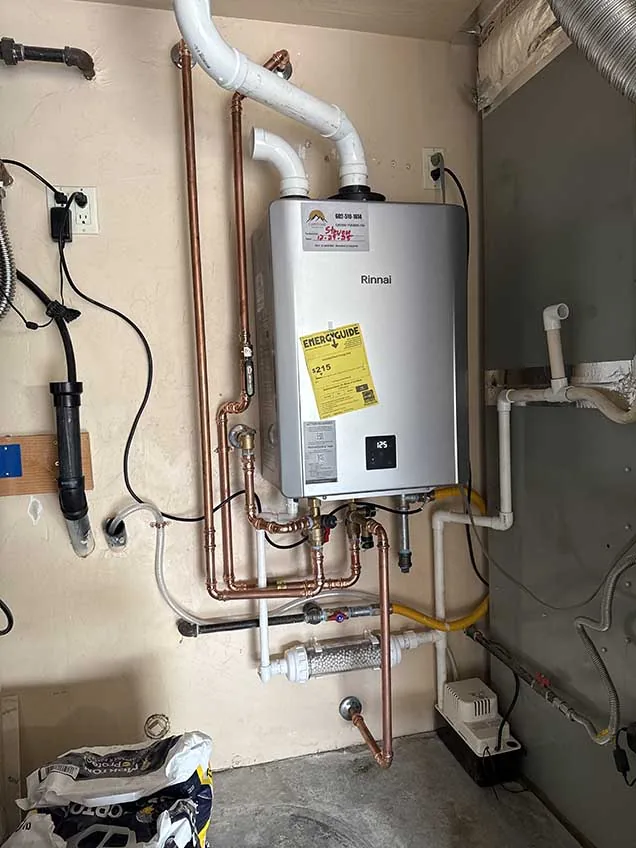
A conventional gas tank runs somewhere around 40,000 BTU per hour. A whole-home gas tankless commonly needs 150,000 to 199,000 — it has to heat water instantly rather than slowly, so it burns far harder while it’s running. That often means a larger gas line from the meter to the unit, and occasionally a meter that can’t supply enough for the whole house once the tankless is added. Neither is exotic work, but both cost money, and neither is visible until someone actually looks at your gas piping.
Venting and condensate
Condensing tankless units vent differently from an old atmospheric tank, with specific materials, clearances and termination points. They also produce condensate — and that condensate is acidic, so it needs a proper drain route and often a neutralizer before it goes anywhere. Where the unit can be mounted is frequently decided by where it can legally and practically vent, not by where you’d prefer it.
Electrical
Even a gas tankless needs power at the unit, which isn’t always present where a tank once stood. Whole-home electric tankless is a different matter again: the electrical service upgrade it demands is substantial, and in most existing North Valley homes it isn’t the practical choice. We’ll tell you plainly if that’s where your house lands.
What we look at: your current fuel source, gas line and meter capacity, available venting routes, condensate drainage, electrical at the unit, where it can actually be mounted, and what the modifications will cost.
3. Will it deliver the performance you’re expecting?
This is where disappointment comes from — not from faulty equipment, but from a mismatch between what people pictured and what the unit was sized to do.
Endless is not the same as unlimited
A tankless heater will produce hot water for as long as you want it. It will not produce an unlimited amount at once. Output is a function of flow rate and temperature rise: how many gallons per minute you’re asking for, and how far the unit has to lift the incoming water temperature to reach your setpoint. Two showers plus a dishwasher is a different demand from one shower, and the unit has to be sized for the worst case you actually care about.
One thing genuinely works in our favour here. Arizona groundwater comes in warmer than it does in most of the country, so the temperature rise required is smaller — which means a given unit delivers more usable gallons per minute in Cave Creek than the identical unit would in a cold climate. Sizing still has to be done properly, but we start from a better position than a plumber in Minnesota.
It will not get hot water to the tap any faster
A tankless unit doesn’t shorten the pipe between the heater and your shower. If you currently wait thirty seconds for hot water, you’ll still be waiting after the conversion — sometimes marginally longer, because the burner has to fire first. If that wait is the thing bothering you, the fix is recirculation, which is a separate decision with its own requirements: either a dedicated return line, or a unit with a built-in pump and buffer designed for it. Worth raising before the install, not after.
Our water will decide how long it lasts
This is the Arizona-specific part, and it matters more than anything else on this page. North Valley water runs 15–20+ grains per gallon. Scale is the single biggest thing that kills tankless performance here — it builds on the heat exchanger, output drops, error codes start appearing, and eventually it fails early. We cover what that hardness does to a house in our guide to hard water in the North Valley.
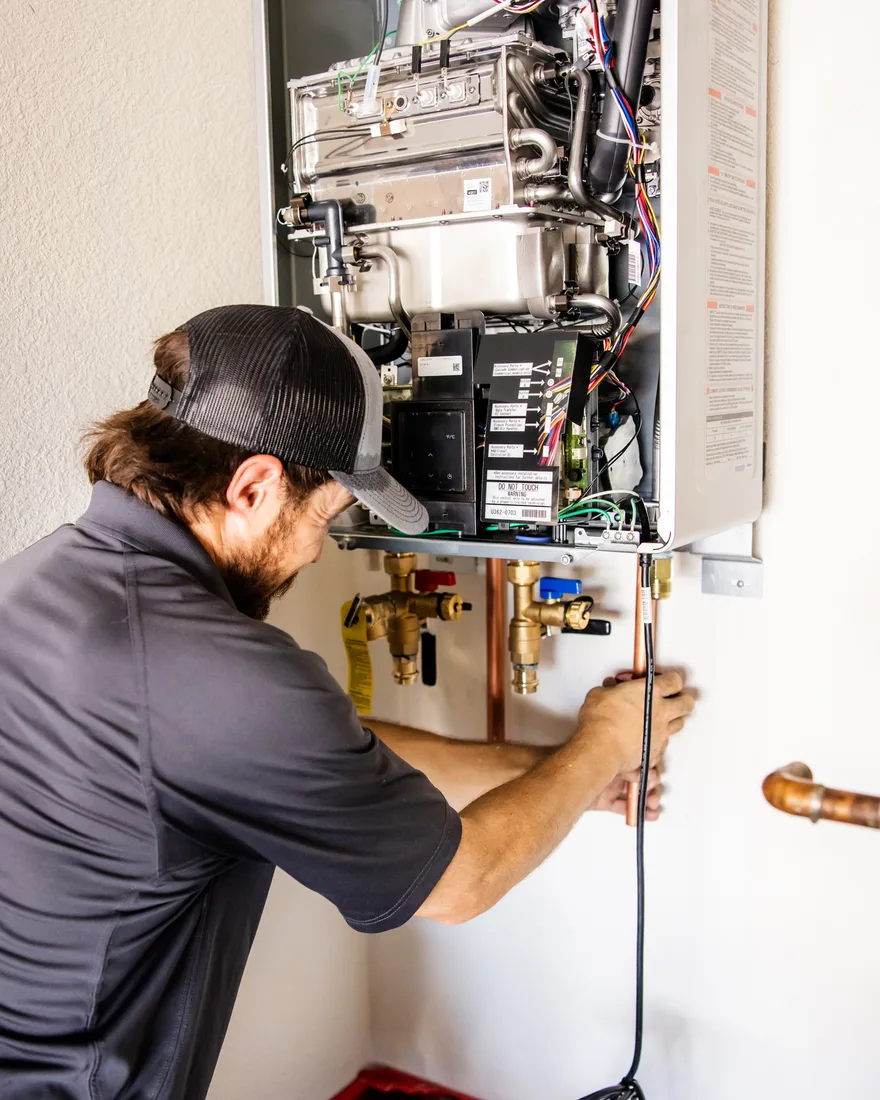
Two practical consequences. First, a tankless unit in this water needs periodic descaling — that’s routine maintenance, not a fault, and it’s why we fit isolation service valves at installation so the unit can actually be flushed. Second, a water softener materially extends the life of a tankless heater here. If you’re investing in a conversion, softening the water that runs through it protects that investment.
What we look at: required flow rate, simultaneous demand, incoming water temperature, hardness, whether you need recirculation, and what the ongoing maintenance looks like.
A note on brands
We install and service more than one brand — Rinnai units are common in our recent work, and the current rebate happens to be a Navien promotion on their NPE-2 line. The right unit for your house is decided by your gas supply, your venting options, your demand and your layout. If a qualifying Navien is the right fit, the $300 is a real bonus on top. If it isn’t, we’ll say so, and you’ll get the heater that suits the house instead of the one with a rebate attached.
What happens when you call us
We come out and look at the house. Gas line and meter, venting routes, condensate, electrical, mounting location, your hot water demand and your water hardness. Then you get a price before any work starts, including whatever modifications your particular house needs — not a range, and no meter running while we work. If the honest answer is that a quality tank heater serves you better, that’s the answer you’ll get.